Long wait but worth it: Certificate of Need (CON)
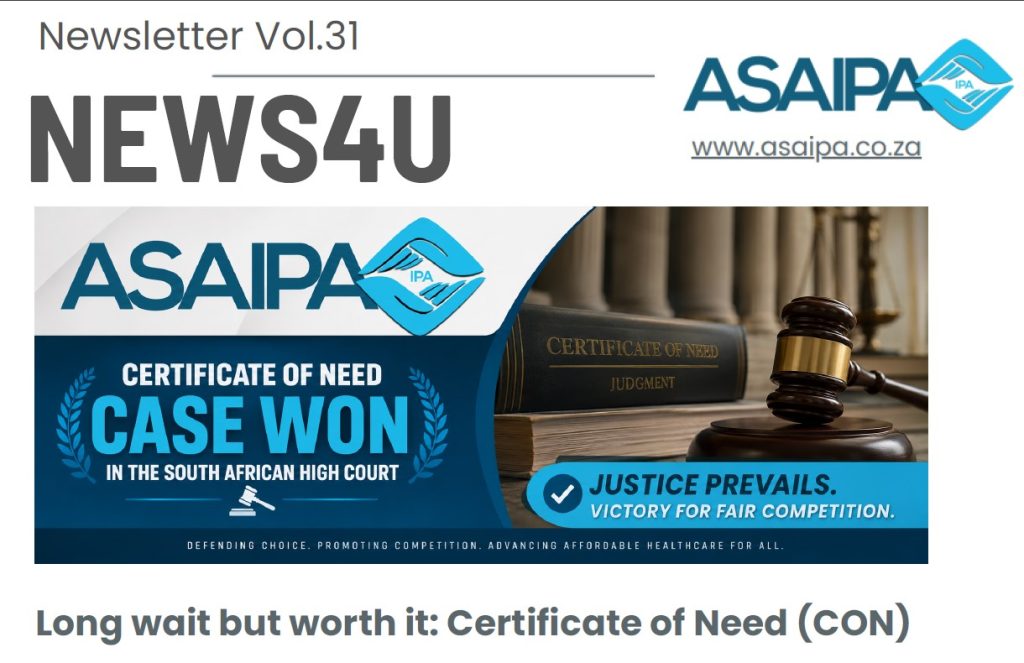
The ASAIPA leadership has expressed both satisfaction and relief that the Constitutional Court has finally confirmed the “constitutional invalidity” of the proposed Certificate of Need (CoN) sections of the National Health Act to end the path of the controversial proposed legislation – to force health practitioners obtain a Certificate of Need from the Department of Health to be able to set up a practice and to provide health care in a specific area.
In late 2021, Solidarity Trade Union, with the support of ASAIPA*, SAPPF and some individual doctors, brought an application to the High Court in Pretoria to have sections of the National Health Act that relate to the CoN, declared unconstitutional. This was granted on 23 June 2022 when the High Court ruled that Sections 36 to 40 of the Health Act 61 of 2003 were “unconstitutional and invalid in their entirety and are consequently severed from the Act”. Respondents were the Minister of Health, President of the Republic of SA, and the Director General: National Department of Health.
ConCourt rules
The matter was subsequently referred to the Constitutional Court for final judgement and on 18 May the highest court in the land handed down a unanimous judgement confirming the 2023 order of the constitutional invalidity of the CoN made by the High Court in Pretoria. In the High Court case it was noted that “ASAIPA has standing to bring the application as an association in its own interests, an association acting in the interests of its members and in the public interest”.
From the outset ASAIPA’s main argument has been that the scheme (CoN) was unconstitutional because, as proposed, it violated the separation of powers, was irrational, prescribed “impermissibly vague criteria”, and “unjustifiably limits constitutional rights” such as freedom of movement, choice of residence, choice of trade, occupation or profession, and everyone’s right to have access to health care.
In short, based on the freedom of rights reflected in Section 22 of the Constitution, the ConCourt found that the scheme proposed threatened choice in the provision of health services while attempting to regulate the practice of a profession. In essence, it would have prohibited people from entering or remaining in the profession without a valid certificate and empowered the Director-General to override practitioners’ choices regarding location, nature, specialty, and financial sustainability.
These limitations, the court felt, were restrictive and not justifiable in terms of the constitution.
*The ASAIPA Exco and board members are very satisfied that sanity prevailed and that the ConCourt ruled in their favour in this matter. This is just another example of the invaluable service that ASAIPA provides to their members, and the medical profession as a whole, on an ongoing basis.
Sincerely,
ASAIPA Communication Department