Dear ASAIPA Member,
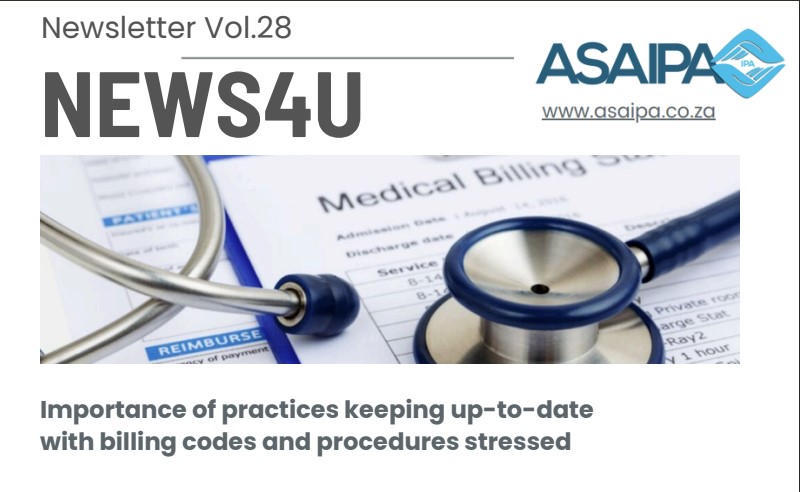
As part of an ongoing commitment to support and protect members’ interests, ASAIPA once again takes this opportunity to stress the critical importance of members and their supporting staff regularly reviewing updated billing codes and ensuring continuing education on correct billing procedures.
In the current healthcare funding environment, medical schemes are applying increasingly stringent audit and compliance measures in terms of Section 59 of the Medical Schemes Act 131 of 1998. These reviews focus on Fraud, Waste and Abuse (FWA) investigations, and it is important to point out here that even unintentional billing errors may result in practices being flagged for inspection.
Why ongoing Code Review is essential
1. New and Updated Codes
Billing codes are regularly amended, withdrawn, or replaced. Failure to implement updated codes correctly may result in:
- Rejected claims
- Delayed reimbursements
- Clawbacks
- Scheme audits
2. Scheme-Specific Rules and Funding Protocols
Medical schemes may apply scheme-specific reimbursement policies, bundling rules, or authorisation requirements. Incorrect application of any one of these increases the risk of claims being classified as irregular.
3. Alignment with Clinical Documentation
Submitted codes must always align with the clinical notes on the patient and associated procedural records. Inconsistencies between documentation and billing are among the primary triggers for FWA reviews.
Importance of Staff Education
Administrative and billing staff play a pivotal role in protecting a practice from unnecessary scrutiny. Regular internal training sessions, therefore, are strongly advised and should cover:
- Understanding current procedural and consultation codes
- Proper use of modifiers
- Authorisation verification processes
- Accurate capturing of ICD-10 codes
- Documentation requirements for higher-level procedures
- Awareness of common billing pitfalls
Section 59: Prevention Is Better Than Investigation
When a medical scheme initiates a Section 59 review under the Medical Schemes Act 131 of 1998, it may
involve:
- Retrospective claim audits
- Request for clinical records
- Withholding of payments
- Clawbacks of previously reimbursed amounts
- Potential reputational impact
Many investigations arise not from intentional misconduct, but from administrative errors, outdated coding, or insufficient internal controls.
Practical Preventative Measures for a Practice
ASAIPA encourages members to implement the following:
- Conduct quarterly internal billing audits
- Review newly published coding updates promptly
- Maintain written billing protocols within the practice
- Ensure accurate and contemporaneous clinical documentation
- Provide structured onboarding and refresher training for billing staff
- Seek clarification from ASAIPA when uncertain about code application*
Always remember: proactive compliance is significantly less disruptive — and less costly — than reactive defense during an audit process. ASAIPA’s Ongoing Support ASAIPA continues to engage with medical schemes and relevant stakeholders to advocate for and promote fair processes and transparency in reimbursement and compliance reviews. Members are also encouraged to report threatening billing challenges to ASAIPA* so that concerns can be addressed collectively and escalated where necessary.
To conclude…
Correct billing is not merely an administrative function. It is a compliance responsibility that protects a member’s practice, reputation, and financial sustainability.
*We urge all members to prioritise code review and ongoing billing education within their practices as a key risk management strategy. Should you require guidance or support, please contact the ASAIPA office tanya@asaipa.co.za
Sincerely,
ASAIPA Communication Department